Strategy - Definition and Features
The word “strategy” is derived from the Greek word “stratçgos”; stratus (meaning army) and “ago” (meaning leading/moving).
Strategy is an action that managers take to attain one or more of the organization’s goals. Strategy can also be defined as “A general direction set for the company and its various components to achieve a desired state in the future. Strategy results from the detailed strategic planning process”.
A strategy is all about integrating organizational activities and utilizing and allocating the scarce resources within the organizational environment so as to meet the present objectives. While planning a strategy it is essential to consider that decisions are not taken in a vaccum and that any act taken by a firm is likely to be met by a reaction from those affected, competitors, customers, employees or suppliers.
Strategy can also be defined as knowledge of the goals, the uncertainty of events and the need to take into consideration the likely or actual behavior of others. Strategy is the blueprint of decisions in an organization that shows its objectives and goals, reduces the key policies, and plans for achieving these goals, and defines the business the company is to carry on, the type of economic and human organization it wants to be, and the contribution it plans to make to its shareholders, customers and society at large.
Features of Strategy
- Strategy is Significant because it is not possible to foresee the future. Without a perfect foresight, the firms must be ready to deal with the uncertain events which constitute the business environment.
- Strategy deals with long term developments rather than routine operations, i.e. it deals with probability of innovations or new products, new methods of productions, or new markets to be developed in future.
- Strategy is created to take into account the probable behavior of customers and competitors. Strategies dealing with employees will predict the employee behavior.
Strategy is a well defined roadmap of an organization. It defines the overall mission, vision and direction of an organization. The objective of a strategy is to maximize an organization’s strengths and to minimize the strengths of the competitors.
Strategy, in short, bridges the gap between “where we are” and “where we want to be”.
Steps in Strategy Formulation Process:
Strategy formulation refers to the process of choosing the most appropriate course of action for the realization of organizational goals and objectives and thereby achieving the organizational vision. The process of strategy formulation basically involves six main steps. Though these steps do not follow a rigid chronological order, however they are very rational and can be easily followed in this order.
- Setting Organizations’ objectives - The key component of any strategy statement is to set the long-term objectives of the organization. It is known that strategy is generally a medium for realization of organizational objectives. Objectives stress the state of being there whereas Strategy stresses upon the process of reaching there. Strategy includes both the fixation of objectives as well the medium to be used to realize those objectives. Thus, strategy is a wider term which believes in the manner of deployment of resources so as to achieve the objectives.While fixing the organizational objectives, it is essential that the factors which influence the selection of objectives must be analyzed before the selection of objectives. Once the objectives and the factors influencing strategic decisions have been determined, it is easy to take strategic decisions.
- Evaluating the Organizational Environment -The next step is to evaluate the general economic and industrial environment in which the organization operates. This includes a review of the organizations competitive position. It is essential to conduct a qualitative and quantitative review of an organizations existing product line. The purpose of such a review is to make sure that the factors important for competitive success in the market can be discovered so that the management can identify their own strengths and weaknesses as well as their competitors’ strengths and weaknesses.After identifying its strengths and weaknesses, an organization must keep a track of competitors’ moves and actions so as to discover probable opportunities of threats to its market or supply sources.
- Setting Quantitative Targets - In this step, an organization must practically fix the quantitative target values for some of the organizational objectives. The idea behind this is to compare with long term customers, so as to evaluate the contribution that might be made by various product zones or operating departments.
- Aiming in context with the divisional plans -In this step, the contributions made by each department or division or product category within the organization is identified and accordingly strategic planning is done for each sub-unit. This requires a careful analysis of macroeconomic trends.
- Performance Analysis - Performance analysis includes discovering and analyzing the gap between the planned or desired performance. A critical evaluation of the organizations past performance, present condition and the desired future conditions must be done by the organization. This critical evaluation identifies the degree of gap that persists between the actual reality and the long-term aspirations of the organization. An attempt is made by the organization to estimate its probable future condition if the current trends persist.
- Choice of Strategy - This is the ultimate step in Strategy Formulation. The best course of action is actually chosen after considering organizational goals, organizational strengths, potential and limitations as well as the external opportunities.
# SWOT Analysis Review
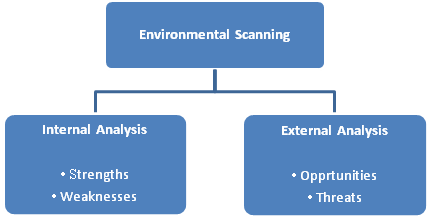
SWOT is an acronym for Strengths, Weaknesses, Opportunities and Threats. By definition, Strengths (S) and Weaknesses (W) are considered to be internal factors over which you have some measure of control. Also, by definition, Opportunities (O) and Threats (T) are considered to be external factors over which you have essentially no control.
SWOT Analysis is the most renowned tool for audit and analysis of the overall strategic position of the business and its environment. Its key purpose is to identify the strategies that will create a firm specific business model that will best align an organization’s resources and capabilities to the requirements of the environment in which the firm operates.
In other words, it is the foundation for evaluating the internal potential and limitations and the probable/likely opportunities and threats from the external environment. It views all positive and negative factors inside and outside the firm that affect the success. A consistent study of the environment in which the firm operates helps in forecasting/predicting the changing trends and also helps in including them in the decision-making process of the organization.
An overview of the four factors (Strengths, Weaknesses, Opportunities and Threats) is given below-
- Strengths - Strengths are the qualities that enable us to accomplish the organization’s mission. These are the basis on which continued success can be made and continued/sustained.Strengths can be either tangible or intangible. These are what you are well-versed in or what you have expertise in, the traits and qualities your employees possess (individually and as a team) and the distinct features that give your organization its consistency.Strengths are the beneficial aspects of the organization or the capabilities of an organization, which includes human competencies, process capabilities, financial resources, products and services, customer goodwill and brand loyalty. Examples of organizational strengths are huge financial resources, broad product line, no debt, committed employees, etc.
- Weaknesses - Weaknesses are the qualities that prevent us from accomplishing our mission and achieving our full potential. These weaknesses deteriorate influences on the organizational success and growth. Weaknesses are the factors which do not meet the standards we feel they should meet.Weaknesses in an organization may be depreciating machinery, insufficient research and development facilities, narrow product range, poor decision-making, etc. Weaknesses are controllable. They must be minimized and eliminated. For instance - to overcome obsolete machinery, new machinery can be purchased. Other examples of organizational weaknesses are huge debts, high employee turnover, complex decision making process, narrow product range, large wastage of raw materials, etc.
- Opportunities - Opportunities are presented by the environment within which our organization operates. These arise when an organization can take benefit of conditions in its environment to plan and execute strategies that enable it to become more profitable. Organizations can gain competitive advantage by making use of opportunities.Organization should be careful and recognize the opportunities and grasp them whenever they arise. Selecting the targets that will best serve the clients while getting desired results is a difficult task. Opportunities may arise from market, competition, industry/government and technology. Increasing demand for telecommunications accompanied by deregulation is a great opportunity for new firms to enter telecom sector and compete with existing firms for revenue.
- Threats - Threats arise when conditions in external environment jeopardize the reliability and profitability of the organization’s business. They compound the vulnerability when they relate to the weaknesses. Threats are uncontrollable. When a threat comes, the stability and survival can be at stake. Examples of threats are - unrest among employees; ever changing technology; increasing competition leading to excess capacity, price wars and reducing industry profits; etc.
Advantages of SWOT Analysis
SWOT Analysis is instrumental in strategy formulation and selection. It is a strong tool, but it involves a great subjective element. It is best when used as a guide, and not as a prescription. Successful businesses build on their strengths, correct their weakness and protect against internal weaknesses and external threats. They also keep a watch on their overall business environment and recognize and exploit new opportunities faster than its competitors.
SWOT Analysis helps in strategic planning in following manner-
- It is a source of information for strategic planning.
- Builds organization’s strengths.
- Reverse its weaknesses.
- Maximize its response to opportunities.
- Overcome organization’s threats.
- It helps in identifying core competencies of the firm.
- It helps in setting of objectives for strategic planning.
- It helps in knowing past, present and future so that by using past and current data, future plans can be chalked out.
SWOT Analysis provide information that helps in synchronizing the firm’s resources and capabilities with the competitive environment in which the firm operates.
Limitations of SWOT Analysis
SWOT Analysis is not free from its limitations. It may cause organizations to view circumstances as very simple because of which the organizations might overlook certain key strategic contact which may occur. Moreover, categorizing aspects as strengths, weaknesses, opportunities and threats might be very subjective as there is great degree of uncertainty in market. SWOT Analysis does stress upon the significance of these four aspects, but it does not tell how an organization can identify these aspects for itself.
There are certain limitations of SWOT Analysis which are not in control of management. These include-
- Price increase;
- Inputs/raw materials;
- Government legislation;
- Economic environment;
- Searching a new market for the product which is not having overseas market due to import restrictions; etc.
- Insufficient research and development facilities;
- Faulty products due to poor quality control;
- Poor industrial relations;
- Lack of skilled and efficient labour; etc
# BCG MATRIX
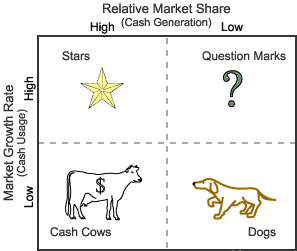
Boston Consulting Group (BCG) Matrix is a four celled matrix (a 2 * 2 matrix) developed by BCG, USA. It is the most renowned corporate portfolio analysis tool. It provides a graphic representation for an organization to examine different businesses in it’s portfolio on the basis of their related market share and industry growth rates. It is a two dimensional analysis on management of SBU’s (Strategic Business Units). In other words, it is a comparative analysis of business potential and the evaluation of environment.
According to this matrix, business could be classified as high or low according to their industry growth rate and relative market share.
Relative Market Share = SBU Sales this year leading competitors sales this year.
Market Growth Rate = Industry sales this year - Industry Sales last year.
Market Growth Rate = Industry sales this year - Industry Sales last year.
The analysis requires that both measures be calculated for each SBU. The dimension of business strength, relative market share, will measure comparative advantage indicated by market dominance. The key theory underlying this is existence of an experience curve and that market share is achieved due to overall cost leadership.
BCG matrix has four cells, with the horizontal axis representing relative market share and the vertical axis denoting market growth rate. The mid-point of relative market share is set at 1.0. if all the SBU’s are in same industry, the average growth rate of the industry is used. While, if all the SBU’s are located in different industries, then the mid-point is set at the growth rate for the economy.
Resources are allocated to the business units according to their situation on the grid. The four cells of this matrix have been called as stars, cash cows, question marks and dogs. Each of these cells represents a particular type of business.
 10 x 1 x 0.1 x |
- Stars- Stars represent business units having large market share in a fast growing industry. They may generate cash but because of fast growing market, stars require huge investments to maintain their lead. Net cash flow is usually modest. SBU’s located in this cell are attractive as they are located in a robust industry and these business units are highly competitive in the industry. If successful, a star will become a cash cow when the industry matures.
- Cash Cows- Cash Cows represents business units having a large market share in a mature, slow growing industry. Cash cows require little investment and generate cash that can be utilized for investment in other business units. These SBU’s are the corporation’s key source of cash, and are specifically the core business. They are the base of an organization. These businesses usually follow stability strategies. When cash cows loose their appeal and move towards deterioration, then a retrenchment policy may be pursued.
- Question Marks- Question marks represent business units having low relative market share and located in a high growth industry. They require huge amount of cash to maintain or gain market share. They require attention to determine if the venture can be viable. Question marks are generally new goods and services which have a good commercial prospective. There is no specific strategy which can be adopted. If the firm thinks it has dominant market share, then it can adopt expansion strategy, else retrenchment strategy can be adopted. Most businesses start as question marks as the company tries to enter a high growth market in which there is already a market-share. If ignored, then question marks may become dogs, while if huge investment is made, then they have potential of becoming stars.
- Dogs- Dogs represent businesses having weak market shares in low-growth markets. They neither generate cash nor require huge amount of cash. Due to low market share, these business units face cost disadvantages. Generally retrenchment strategies are adopted because these firms can gain market share only at the expense of competitor’s/rival firms. These business firms have weak market share because of high costs, poor quality, ineffective marketing, etc. Unless a dog has some other strategic aim, it should be liquidated if there is fewer prospects for it to gain market share. Number of dogs should be avoided and minimized in an organization.
Limitations of BCG Matrix
The BCG Matrix produces a framework for allocating resources among different business units and makes it possible to compare many business units at a glance. But BCG Matrix is not free from limitations, such as-
- BCG matrix classifies businesses as low and high, but generally businesses can be medium also. Thus, the true nature of business may not be reflected.
- Market is not clearly defined in this model.
- High market share does not always leads to high profits. There are high costs also involved with high market share.
- Growth rate and relative market share are not the only indicators of profitability. This model ignores and overlooks other indicators of profitability.
- Digital Technology gives high possibility of Earnings with relative low market share .
- At times, dogs may help other businesses in gaining competitive advantage. They can earn even more than cash cows sometimes.
- This four-celled approach is considered as to be too simplistic.
# Porter’s Five Forces Analysis of the Airlines Industry in the United States
Five Forces Analysis
Porter’s Five Forces analysis is a useful methodology and a tool to analyze the external environment in which any industry operates. The key aspect about using Porter’s Five Forces for the airline industry in the United States is that the airline industry has been buffeted by strong headwinds from a host of external factors that include declining passenger traffic, increasing operating expenses, high fuel prices, and greater landing and maintenance costs, apart from intense competition from low cost carriers that has led to a cutthroat price war which has led the industry severely affected. Indeed, it can be said that the airline industry globally is in a “death spiral” and more so in the United States where several prominent carriers were either forced into bankruptcy or had to merge with other airlines just to stay afloat.
Supplier Power
The power of suppliers in the airline industry is immense because of the fact that the three inputs that airlines have in terms of fuel, aircraft, and labor are all affected by the external environment. For instance, the price of aviation fuel is subject to the fluctuations in the global market for oil, which can gyrate wildly because of geopolitical and other factors. Similarly, labor is subject to the power of the unions who often bargain and get unreasonable and costly concessions from the airlines. Third, the airline industry needs aircraft either on outright sale or wet lease basis which means that the airlines have to depend on the two biggies, Airbus, and Boeing for their aircraft needs. This is the reason the power of the suppliers in terms of the three inputs needed for them is categorized as high according to the Porter’s Five Forces framework.
Buyer Power
With the proliferation of online ticketing and distribution systems, fliers no longer have to be at the mercy of the agents and the intermediaries as well the airlines themselves for their ticketing needs. Apart from, the entry of low cost carriers and the resultant price wars has greatly benefited the fliers. Moreover, the tight regulation on the demand side of the airline industry meaning that passengers and fliers have been protected by the regulators means that the balance of power is tipped in their favor. All these factors make the airline industry cede power to the consumers and hence, the power of buyers is moderate to high as per Porter’s Five Forces methodology. Apart from this, the buyers can engage in “price discovery” meaning that price fluctuations do not deter them as they have multiple channels through which they can book their tickets.
Entry and Exit Barriers
The airline industry needs huge capital investment to enter and even when airlines have to exit the sector, they need to write down and absorb many losses. This means that the entry and exit barriers are high for the airline industry. As entry into the airline industry needs a high infusion of capital, not everybody can enter the industry, which in addition, needs sophisticated knowledge and expertise on part of the players, which is a deterrent. The exit barriers are also subject to regulation as regulators in the United States do not let airlines exit the industry unless they are satisfied that there is a genuine business reason for the same. Moreover, the airline industry leverages the efficiencies and the synergies from the economies of scale and hence, the entry barriers are high. Therefore, applying Porter’s Five Forces framework, we find that the airlines pose significant entry and exit barriers, which means that the impact of this dimension is quite high.
Threat of Substitutes and Complementarities
The airline industry in the United States is not at threat from substitutes and complementarities as unlike in the developing world, consumers do not necessarily take the train or the bus for journeys. What this means is that flying is a natural phenomenon for the consumers and hence, the substitutes in terms of the train and bus is minimal in its impact. Of course, many Americans motor down (use their cars for longer travel as well) which means that there is the threat of this substitute. As for complementarities, the provision of services like free Wi-Fi, a la carte meals, and passenger amenities offered by the full service airlines does not really translate into more passengers as in the recent past; fliers have been induced more by lower fares than these aspects.
Intensity of Competitive Rivalry
As mentioned in the introduction, the airline industry in the United States is extremely competitive because of a number of reasons which include entry of low cost carriers, the tight regulation of the industry wherein safety become paramount leading to high operating expenses, and the fact that the airlines operate according to a business model that is a bit outdated especially in times of rapid turnover and churn in the industry. Apart from anything else, the airline industry is regulated on the supply side more than the demand side, which means that instead of the airlines being free to choose which markets to operate and which segments to target, it is the fliers who get to be pampered by the regulators. This is the reason why low cost carriers have literally grounded the full service airlines and when combined with the intense competition that was always the case in the United States, the result is that the sector is one of the most competitive in the country.
# VALUE CHAIN ANALYSIS :
Manufacturing companies create value by acquiring raw materials and using them to produce something useful. Retailers bring together a range of products and present them in a way that's convenient to customers, sometimes supported by services such as fitting rooms or personal shopper advice. And insurance companies offer policies to customers that are underwritten by larger re-insurance policies. Here, they're packaging these larger policies in a customer-friendly way, and distributing them to a mass audience.
The value that's created and captured by a company is the profit margin:
Value Created and Captured – Cost of Creating that Value = Margin
The more value an organization creates, the more profitable it is likely to be. And when you provide more value to your customers, you build competitive advantage.
Understanding how your company creates value, and looking for ways to add more value, are critical elements in developing a competitive strategy. Michael Porter discussed this in his influential 1985 book "Competitive Advantage," in which he first introduced the concept of the value chain.
A value chain is a set of activities that an organization carries out to create value for its customers. Porter proposed a general-purpose value chain that companies can use to examine all of their activities, and see how they're connected. The way in which value chain activities are performed determines costs and affects profits, so this tool can help you understand the sources of value for your organization.
Elements in Porter's Value Chain
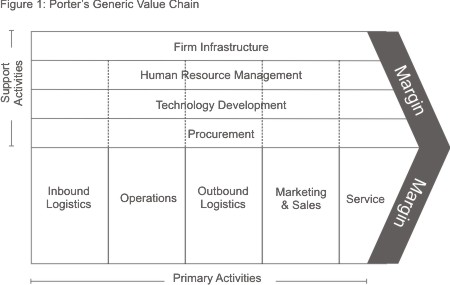
Rather than looking at departments or accounting cost types, Porter's Value Chain focuses on systems, and how inputs are changed into the outputs purchased by consumers. Using this viewpoint, Porter described a chain of activities common to all businesses, and he divided them into primary and support activities, as shown below.
Primary Activities
Primary activities relate directly to the physical creation, sale, maintenance and support of a product or service. They consist of the following:
- Inbound logistics – These are all the processes related to receiving, storing, and distributing inputs internally. Your supplier relationships are a key factor in creating value here.
- Operations – These are the transformation activities that change inputs into outputs that are sold to customers. Here, your operational systems create value.
- Outbound logistics – These activities deliver your product or service to your customer. These are things like collection, storage, and distribution systems, and they may be internal or external to your organization.
- Marketing and sales – These are the processes you use to persuade clients to purchase from you instead of your competitors. The benefits you offer, and how well you communicate them, are sources of value here.
- Service – These are the activities related to maintaining the value of your product or service to your customers, once it's been purchased.
Support Activities
These activities support the primary functions above. In our diagram, the dotted lines show that each support, or secondary, activity can play a role in each primary activity. For example, procurement supports operations with certain activities, but it also supports marketing and sales with other activities.
- Procurement (purchasing) – This is what the organization does to get the resources it needs to operate. This includes finding vendors and negotiating best prices.
- Human resource management – This is how well a company recruits, hires, trains, motivates, rewards, and retains its workers. People are a significant source of value, so businesses can create a clear advantage with good HR practices.
- Technological development – These activities relate to managing and processing information, as well as protecting a company's knowledge base. Minimizing information technology costs, staying current with technological advances, and maintaining technical excellence are sources of value creation.
- Infrastructure – These are a company's support systems, and the functions that allow it to maintain daily operations. Accounting, legal, administrative, and general management are examples of necessary infrastructure that businesses can use to their advantage.
Companies use these primary and support activities as "building blocks" to create a valuable product or service.
Using Porter's Value Chain
To identify and understand your company's value chain, follow these steps.
Step 1 – Identify subactivities for each primary activity
For each primary activity, determine which specific subactivities create value. There are three different types of subactivities:
- Direct activities create value by themselves. For example, in a book publisher's marketing and sales activity, direct subactivities include making sales calls to bookstores, advertising, and selling online.
- Indirect activities allow direct activities to run smoothly. For the book publisher's sales and marketing activity, indirect subactivities include managing the sales force and keeping customer records.
- Quality assurance activities ensure that direct and indirect activities meet the necessary standards. For the book publisher's sales and marketing activity, this might include proofreading and editing advertisements.
Step 2 – Identify subactivities for each support activity.
For each of the Human Resource Management, Technology Development and Procurement support activities, determine the subactivities that create value within each primary activity. For example, consider how human resource management adds value to inbound logistics, operations, outbound logistics, and so on. As in Step 1, look for direct, indirect, and quality assurance subactivities.
Then identify the various value-creating subactivities in your company's infrastructure. These will generally be cross-functional in nature, rather than specific to each primary activity. Again, look for direct, indirect, and quality assurance activities.
Step 3 – Identify links
Find the connections between all of the value activities you've identified. This will take time, but the links are key to increasing competitive advantage from the value chain framework. For example, there's a link between developing the sales force (an HR investment) and sales volumes. There's another link between order turnaround times, and service phone calls from frustrated customers waiting for deliveries.
The value chain was first developed as a business idea in the second chapter of “Competitive Advantage: Creating and Sustaining Superior Performance” by Michael Porter, first published in 1985. In it he wrote:
A systematic way of examining all the activities a firm performs and how they interact is necessary for analysing the sources of competitive advantage. In this chapter, I introduce the value chain as the basic tool for doing so.
In the decade after the book was published, the idea became one of the most discussed and most misunderstood in the whole of the management arena. Each link in a value chain consists of a bundle of activities (value activities), and these bundles are performed by a firm to “design, produce, market, deliver and support its product”. “Value activities are the discrete building blocks of competitive advantage,” wrote Porter.
Rival firms may have similar chains, but they may also have very different ones. Porter quoted the example of People Express, one of the earliest of the low-cost airlines, and United Airlines, a more traditional firm. They were both in the same business, but there were significant differences in the way that, for example, they ran their boarding-gate operations, their aircraft operations and their crews. Differences such as these, claimed Porter, are a principal source of competitive advantage.
Critics of the idea focused on the difficulty in identifying the discrete building blocks. Without defining them carefully it is not possible to compare and contrast them with those of rivals and thereby to seek ways of gaining competitive advantage. Porter tried to help. He said:
[Every value activity] employs purchased inputs, human resources (labour and management), and some form of technology to perform its function. Each value activity also uses and creates information … the appropriate degree of disaggregation depends on the economics of the activities and the purposes for which the value chain is being analysed.
He also said a bit about what value chains were not. For instance: “Value activities and accounting classifications are rarely the same,” he explained. But still, most firms found it hard to spot a value activity when it hit their factory floor. Non-manufacturing businesses found it even harder.
Since the idea of the value chain was first introduced, it has been taken in a number of different directions. One has attempted to extend it beyond the straightforward manufacturing processes for which it was, in its early form, most suited.
In 1993, Richard Norman and Rafael Ramirez argued that the value chain was outdated, suited to a slower changing world of comparatively fixed markets. Companies in the 1990s, they said, needed not just to add value but to “reinvent” it. This they could do by reconfiguring roles and relationships between “a constellation of actors” —suppliers, partners, customers, and so on. One company they pointed to as having done this particularly well was IKEA, a Swedish-based international retailer of home furniture.
Later on, Jeffrey Rayport and John Sviokla applied the idea to the virtual world, the world of information, arguing that managers must pay attention to the way in which value chains work in both the tangible world of the marketplace and the virtual world of the market space. Just as companies take raw materials and refine them into products, so (increasingly) do they also take raw information and add value from a chain of five activities: information gathering, organising, selecting, synthesising and distributing.
Comments
Post a Comment